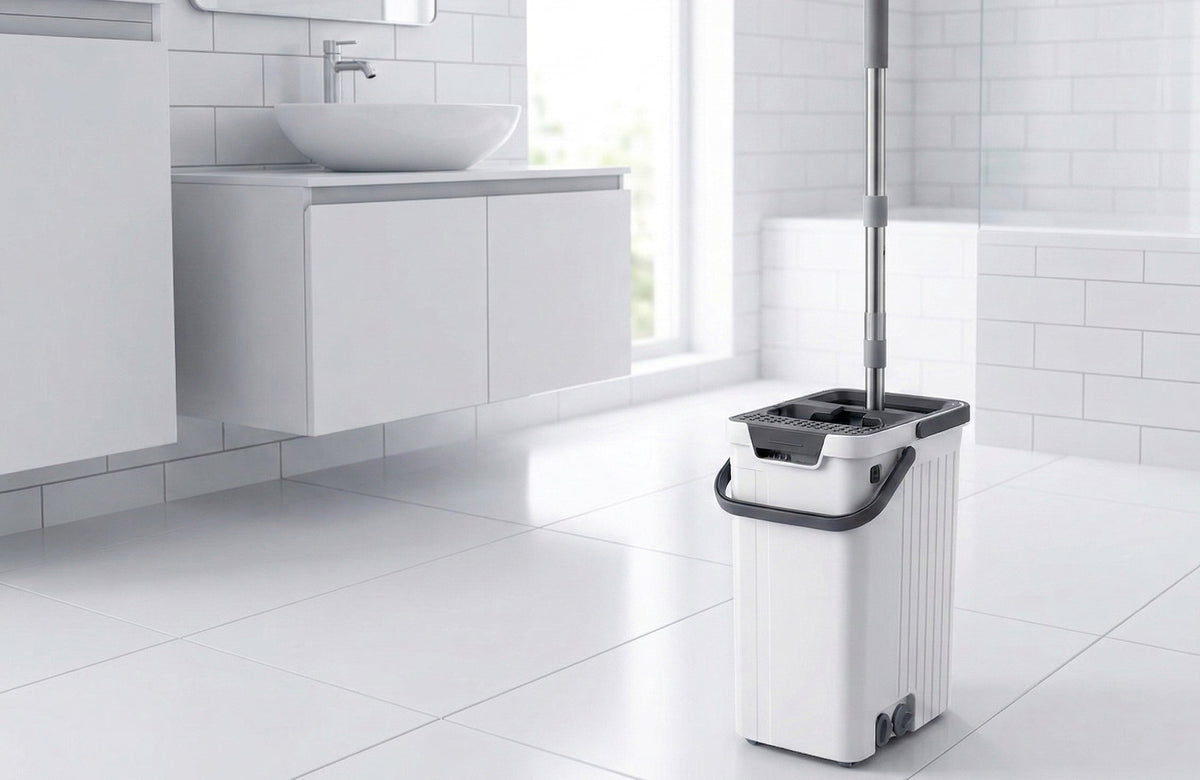
Steam cleaning has become one of the most effective and chemical-free ways to maintain a genuinely clean home. But when it comes to choosing the right tool, the decision between a handheld steam cleaner and a steam mop stops a lot of buyers in their tracks.
Both use high-temperature steam. Both clean without chemicals. Both kill bacteria and sanitize surfaces on contact. So what's actually different—and does it matter enough to affect which one you should buy?
The answer depends almost entirely on how you clean, what surfaces you're cleaning, and whether your home's needs are primarily floor-focused or spread across multiple surface types. This guide lays out the real differences between the two so you can make the right call for your specific situation—without spending money on a tool that only covers half of what you need.
What a Steam Mop Is Designed to Do
A steam mop is built around one specific task: cleaning floors.
The design reflects that focus entirely. A steam mop consists of a long upright handle, a flat floor head with a microfiber or steam-permeable pad attached to the bottom, and a water tank—usually positioned on the handle—that feeds steam downward through the floor head as the user pushes the mop across the surface.
The mechanics are optimized for floor contact. The flat head maintains consistent surface contact across the full width of the pad with every pass. The downward steam direction drives heat and moisture directly into the floor surface. The upright handle allows the user to cover ground efficiently without bending.
What a steam mop does well, it does very well. Hard floor surfaces—tile, sealed hardwood, laminate, vinyl, stone—respond well to the consistent, pressurized steam delivered through a floor mop head. Grout between floor tiles gets targeted heat that loosens embedded contamination. The floor pad picks up what the steam loosens and holds it for removal.
The limitation is structural: the steam mop is designed for horizontal floor surfaces. The fixed floor head, downward steam direction, and upright handle geometry make it difficult to redirect steam onto vertical surfaces, into elevated appliances, or into the tight spaces that make up the rest of a home's cleaning needs. Some steam mops include a detachable handheld unit or accessory attachments for non-floor use, but these additions rarely perform as well as a dedicated handheld steam cleaner at the same tasks.
What a Handheld Steam Cleaner Is Designed to Do
A handheld steam cleaner is built around versatility rather than floor-specific performance.
The compact, handheld form factor allows the unit to be directed at any surface, at any angle, at any height. The same unit that cleans bathroom tile grout can be turned upward to treat a range hood filter, held horizontally to clean a stovetop, pointed at a sofa cushion to refresh fabric, or pressed into a window track to clear accumulated debris. The steam direction follows the user's hand, not a fixed floor-oriented geometry.
This versatility is enabled by the attachment system. Different nozzle and brush attachments change how steam is dispersed—a concentrated jet for grout and crevices, a wide brush for flat surfaces, a cloth cover for fabric, a narrow brush for edges and tracks. The core unit is the same; the attachment changes what surface it's addressing and how the steam makes contact with it.
For a home where the cleaning challenges are distributed across kitchens, bathrooms, upholstery, appliances, windows, and floors—which describes most households—a handheld steam cleaner covers the full range. A steam mop covers the floor portion of that list and typically nothing else with equivalent effectiveness.
The trade-off is floor-specific performance. A dedicated steam mop, optimized for floor contact, covers ground more quickly on open floor areas than a handheld unit with a floor attachment. For households where floors represent the primary or exclusive cleaning challenge, that trade-off matters. For households with mixed surface cleaning needs, it often doesn't.
Head-to-Head Comparison

1. Surface Versatility
This is the most significant practical difference between the two tools.
A steam mop addresses floor surfaces. Full stop. The design optimizes for that single use case and sacrifices flexibility in every other direction. Some models include clip-on accessories for countertops or fabric, but the handheld component of a steam mop combo unit is usually smaller, lighter, and less powerful than a standalone handheld steam cleaner—a compromise rather than a genuine solution.
A handheld steam cleaner addresses floors (with a floor attachment), kitchen surfaces, bathroom tile and grout, appliance interiors and exteriors, upholstery, curtains, windows, baseboards, and any other surface in the home that responds to high-temperature steam treatment. One unit, one fill, one cleaning session that moves through the entire home without switching tools.
For households that genuinely only mop floors and have no other steam cleaning needs, the surface versatility of a handheld unit is irrelevant. For everyone else, it's the defining difference.
Winner: Handheld steam cleaner
2. Floor Cleaning Performance
On open floor areas specifically, a steam mop has a genuine performance advantage.
The floor head of a steam mop covers a wider path per pass than most handheld steam cleaner floor attachments. The downward steam direction is optimized for floor contact. The upright handle geometry means the user can cover ground efficiently without the wrist positioning required when using a handheld unit at floor level for extended periods.
For large open floor areas—open-plan living spaces, long hallways, large kitchens—a steam mop completes the task faster and with less physical effort than a handheld unit used at floor level.
For smaller floor areas with more obstacles—bathrooms, kitchens with multiple appliances, spaces with furniture close to the floor—the maneuverability advantage of a steam mop narrows considerably. The fixed floor head geometry that makes steam mops efficient on open surfaces becomes a limitation in confined or obstacle-dense floor plans.
Winner: Steam mop (on large open floor areas specifically)
3. Reach and Maneuverability
Steam mops are designed to operate at floor level. Working on anything above that height—a countertop, an appliance, a bathroom wall—requires tilting the unit in ways it isn't built for, often with limited effectiveness and some risk to the floor or nearby surfaces from misdirected steam.
A handheld steam cleaner operates at whatever height and angle the user positions it. Overhead surfaces, vertical tile, inside appliances, beneath furniture—all of these are accessible without adapting the unit to a use case it wasn't designed for. The compact form factor works in tight spaces under cabinets, inside oven interiors, and in the narrow gap between a toilet and a wall.
For a home cleaning routine that moves between floor level and other surfaces, this matters practically every session.
Winner: Handheld steam cleaner
4. Grout Cleaning — Floor vs Wall
Both tools clean floor grout. The difference is in what else they clean.
A steam mop treats floor grout as part of its standard floor-cleaning pass. The downward steam direction and flat head engagement work reasonably well on floor grout between tiles. For heavily embedded floor grout contamination, a steam mop with a scrubbing brush attachment performs better than a basic pad.
A handheld steam cleaner treats floor grout and wall grout and shower grout and backsplash grout—all with the same unit, using the same concentrated jet nozzle attachment. Bathroom walls, shower enclosures, and kitchen backsplashes represent the majority of grout surface area in most homes, and a steam mop reaches none of them. A handheld unit reaches all of them.
Winner: Handheld steam cleaner
5. Kitchen Cleaning
The kitchen is where the steam mop's floor-only limitation becomes most apparent in practice.
A kitchen cleaning session that uses a steam mop covers the kitchen floor. The stovetop, range hood, oven interior, microwave, cabinet door fronts, backsplash tile, sink area, and countertop—all of these require either separate tools and products or a handheld steam cleaner that can be redirected to each surface.
With a handheld unit, a complete kitchen clean is a single-tool session. The same fill of water that cleans the stovetop grease treats the backsplash grout, refreshes the microwave interior, cleans the range hood filter, and ends with a floor pass using the floor attachment. No product switching, no additional tools, no chemical residue on food-preparation surfaces.
Winner: Handheld steam cleaner
6. Bathroom Cleaning
Bathrooms present the same multi-surface challenge as kitchens, concentrated in a smaller space.
Effective bathroom cleaning requires treating the floor, the tile walls around the shower or tub, the shower door tracks and seals, the toilet exterior, the sink and faucet area, and the grout on every tiled surface. A steam mop handles the floor. Everything else requires a different tool.
A handheld steam cleaner handles the bathroom floor with a floor attachment, then redirects to shower tile, grout lines, the toilet base and exterior, faucet mineral deposits, and door track debris—all in a single session with the same water fill. For a bathroom where every surface benefits from high-temperature steam treatment, the handheld unit is the obvious choice.
Winner: Handheld steam cleaner
7. Fabric and Upholstery
Steam mops are not designed for fabric surfaces. The floor head, downward steam direction, and pressure levels optimized for hard floor contact are inappropriate for upholstery, curtains, mattresses, or clothing. Attempting to use a steam mop on fabric typically produces oversaturation and potential surface damage.
A handheld steam cleaner with a fabric-specific attachment—a cloth cover or diffusing nozzle that softens steam impact—is one of the most effective tools available for refreshing upholstery, deodorizing mattresses, and treating fabric surfaces without chemical products. Dust mites in mattresses and upholstery are killed by the high-temperature steam. Odors embedded in fabric are neutralized by heat rather than masked by fragrances.
Winner: Handheld steam cleaner
8. Ease of Use for Floor-Only Cleaning
If the task is exclusively floor cleaning, a steam mop is simply more convenient to use for that specific purpose.
The upright handle and floor-optimized geometry mean the user can clean floors without bending, without adapting their posture to compensate for a handheld unit being used at floor level, and without the wrist positioning that comes with directing a compact handheld unit across a large floor area.
For users who primarily need floor cleaning and have a dedicated floor cleaning routine separate from other surface cleaning tasks, the ergonomic advantage of a steam mop for floor-only use is real.
Winner: Steam mop (for floor-only use specifically)
9. Storage Footprint
Steam mops require upright storage and take up more floor space than a compact handheld unit. The long handle and floor head, while manageable in a utility closet, are larger than a handheld steam cleaner and its attachments.
A handheld steam cleaner stores compactly—a shelf in a cabinet, a hook on a wall, or in a small drawer with attachments organized alongside. For homes where storage space is limited, the smaller footprint of a handheld unit is a meaningful practical consideration.
Winner: Handheld steam cleaner
10. Upfront Cost
Steam mops are generally less expensive than quality handheld steam cleaners at the same performance tier. The more focused design and simpler attachment system translate to lower manufacturing cost and lower retail price for comparable steam output specifications.
For buyers whose needs are genuinely floor-limited, a steam mop at a lower price point that covers those needs effectively is the more economical choice. For buyers who need whole-home coverage, a steam mop purchased to cover the floor portion of that need requires additional tools and products for everything else—making the total cost of meeting whole-home cleaning needs higher than a single handheld unit would be.
Winner: Steam mop (on upfront cost for floor-only use); handheld steam cleaner (on total cost for whole-home needs)
Who Should Buy a Steam Mop
A steam mop is the right choice if:
Your home has large areas of hard flooring that represent the primary cleaning challenge—open-plan living areas, long hallways, large kitchens with minimal appliances on the floor.
You clean floors on a regular schedule and have separate products or tools already handling other surface cleaning needs that you're satisfied with.
Floor cleaning speed and efficiency on open surfaces is the primary performance priority.
Upfront cost is a significant consideration and floor cleaning is the dominant need.
You have minimal bathroom tile, limited kitchen appliances, and little upholstered furniture that would benefit from steam treatment.
Who Should Buy a Handheld Steam Cleaner

A handheld steam cleaner is the right choice if:
Your home has multiple surface types that benefit from steam treatment—tiled bathrooms, a kitchen with a stovetop and appliances, upholstered furniture, grout on walls and floors.
You want one tool that handles the full range of home cleaning rather than multiple specialized products for different surfaces.
You're replacing chemical cleaning products with steam as the primary motivation, which requires treating all the surfaces those products currently address—not just floors.
Storage space is limited and a compact tool that stores easily is important.
You have a bathroom where wall tile, shower grout, and fixture cleaning are as important as the floor.
You cook regularly and need an effective solution for stovetop and kitchen appliance cleaning without chemical residue near food preparation surfaces.
Can You Use Both?
Yes—and for some households, both tools serve distinct roles effectively.
A steam mop for regular floor maintenance in open-plan areas, where its efficiency advantage on large flat surfaces is most relevant. A handheld steam cleaner for kitchen and bathroom surfaces, appliances, upholstery, and periodic deep cleaning of floor grout and tile in confined spaces where the handheld unit's maneuverability outperforms the steam mop's fixed geometry.
This combination makes sense for larger homes where the floor area is substantial enough to justify a dedicated floor tool, alongside enough other surface cleaning needs to warrant a handheld unit. For most households, however, the handheld unit covers both roles adequately—the floor attachment handles floor cleaning, while the rest of the attachment set addresses everything the steam mop cannot.
The Bottom Line
The choice between a handheld steam cleaner and a steam mop comes down to one question: is your cleaning challenge primarily about floors, or about the home as a whole?
If it's floors—large open floors, cleaned regularly, with other surface needs handled separately—a steam mop is a focused, efficient tool for that specific task.
If it's the home as a whole—kitchens, bathrooms, upholstery, appliances, grout on walls and floors, and everything else that accumulates contamination between cleaning sessions—a handheld steam cleaner is the only tool that covers the full scope without requiring additional products for the surfaces it can't reach.
For most households, where cleaning needs are distributed across multiple room types and surface categories, the handheld steam cleaner is the more practical and more complete answer.
Frequently Asked Questions
Is a handheld steam cleaner as good as a steam mop for floors? For large open floor areas, a steam mop is slightly more efficient due to its wider floor head and optimized downward steam direction. For smaller floor areas with obstacles, confined bathrooms, or any floor cleaning that's part of a broader multi-surface session, a handheld steam cleaner with a floor attachment performs comparably with significantly more versatility.
Can a handheld steam cleaner replace a steam mop? For most home cleaning needs, yes. A handheld steam cleaner with a floor attachment handles floor cleaning while also addressing kitchens, bathrooms, appliances, upholstery, and other surfaces a steam mop cannot reach. Households with very large open floor areas may find a dedicated steam mop more efficient for that specific task, but a handheld unit covers the full scope of home cleaning needs in a single tool.
Which is better for grout cleaning—a handheld steam cleaner or a steam mop? A handheld steam cleaner is more versatile for grout cleaning because it addresses grout on floors, walls, shower enclosures, and kitchen backsplashes. A steam mop addresses floor grout only. For homes where bathroom and kitchen wall grout is as important as floor grout, the handheld unit is the more complete solution.
Are steam mops safe for all floor types? Steam mops are compatible with most sealed hard floor surfaces—tile, sealed hardwood, laminate, and vinyl. Unsealed hardwood and certain natural stone floors require caution, as sustained moisture and heat can cause damage. Always check the floor manufacturer's guidance before using any steam tool on a new surface type.
Do handheld steam cleaners work on fabric and upholstery? Yes, with the appropriate fabric-specific attachment. A diffusing nozzle or cloth cover softens steam impact for safe application on upholstery, mattresses, and curtains. Steam mops are not designed for fabric surfaces and should not be used on upholstery.
Which tool is better for a small apartment? A handheld steam cleaner. In a small apartment, the floor areas are typically modest in size and obstacle-dense, reducing the efficiency advantage of a steam mop on open floor space. The handheld unit covers every surface in the apartment—including the compact bathroom and kitchen that a small apartment typically has—without the storage footprint of an upright steam mop.
What's the main disadvantage of a handheld steam cleaner compared to a steam mop? On large open floor areas, a handheld steam cleaner is slightly less efficient than a steam mop—the floor head attachment is typically narrower than a steam mop head, requiring more passes to cover the same area. For households where large open floor coverage is the primary need, this is a meaningful difference. For mixed-use cleaning, it's a minor trade-off relative to the versatility advantage of the handheld format.
The ADICOM Handheld Steam Cleaner heats up in 3 seconds, weighs just 2 lbs, and includes a practical range of attachments for whole-home use—from floor cleaning to kitchen and bathroom surfaces, upholstery, grout, and more. One tool for everything steam can clean. Learn more here.