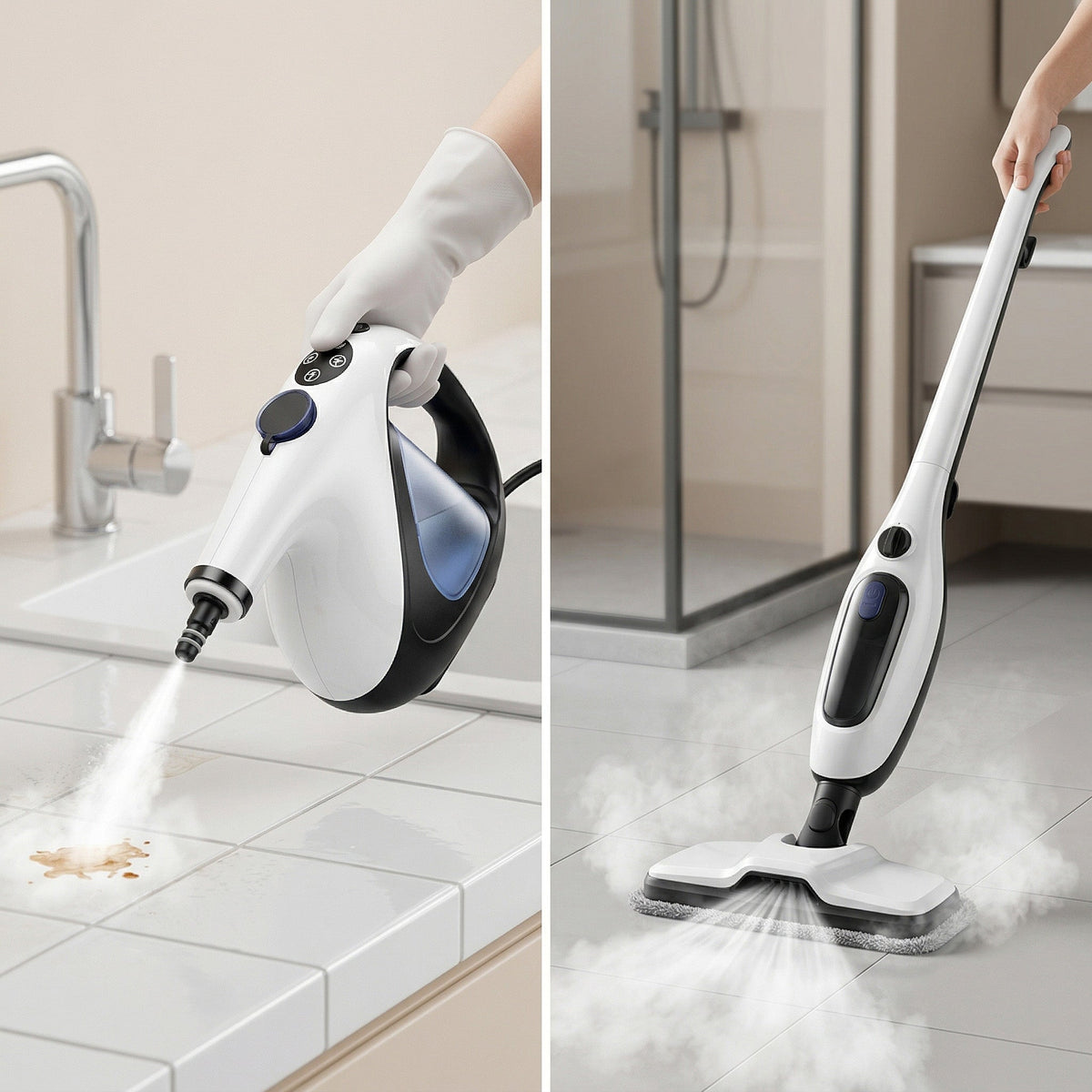
Best Handheld Steam Cleaner for Home Use: What to Look For
The promise of a handheld steam cleaner for home use is straightforward: high-temperature steam that cleans and sanitizes without chemicals, across a range of surfaces, in a compact unit that's ready when you need it.
The reality is more complicated. The market for handheld steam cleaners ranges from genuinely effective tools that deliver on that promise to budget units that produce warm mist, take several minutes to heat up, and leave surfaces wetter than before. The difference between them isn't always obvious from a product listing—specifications are often incomplete, and marketing language rarely explains what actually matters for day-to-day home cleaning performance.
This guide cuts through that. Here's what the key features actually mean in practice, which ones make a measurable difference in cleaning results, and what to prioritize when choosing a handheld steam cleaner for home use.
Why Handheld Steam Cleaners Have Become a Home Cleaning Staple
The shift toward handheld steam cleaners in home cleaning routines has been driven by a few converging factors that go beyond trend.
Chemical cleaning products have become a growing concern for households with young children, pets, and anyone with respiratory sensitivities or skin reactions to cleaning product ingredients. Steam cleaning eliminates the chemical variable entirely—the only active ingredient is heat, which kills the same pathogens that chemical disinfectants target without leaving residue on surfaces that family members touch, breathe near, or walk on.
Versatility is the second driver. A single handheld steam cleaner for home use replaces multiple specialized products: bathroom tile cleaner, grout treatment, fabric refresher, kitchen degreaser, appliance cleaner. One tool, one water fill, the same cleaning mechanism across all of these tasks—with the right attachments.
The third factor is improved technology in compact form. Early handheld steam cleaners required several minutes to heat up, had small tanks that ran out quickly, and produced inconsistent steam output. Current designs have closed the gap significantly on all three fronts. The best models heat up in seconds, maintain consistent output throughout a session, and are light enough to use without fatigue on extended cleaning tasks.
Understanding which specific design improvements actually matter—and which are marketing rather than performance—is the core of making a good buying decision.
Feature 1: Heat-Up Time
Heat-up time is the single most important usability factor in a handheld steam cleaner for home use—and the one most likely to determine whether the tool gets used regularly or ends up in a cabinet.
The psychology is simple: a tool that takes three to five minutes to reach operating temperature won't be used for quick, unplanned cleaning tasks. A spill on the stovetop, a soap scum buildup in the bathroom, or a quick refresh of a couch cushion before guests arrive—these are tasks where a handheld steam cleaner should be the natural instinct. If reaching for it means a five-minute wait, the spray bottle on the counter wins by default, and the steam cleaner becomes a scheduled deep-cleaning tool rather than an everyday one.
The gap between designs is significant. Older integrated-tank steam cleaners typically require three to five minutes to build pressure and reach operating temperature. This isn't a minor inconvenience—it fundamentally changes how the tool is used and how often.
Modern instant-heat designs reach full operating temperature in as little as three seconds. At that speed, the heat-up period is effectively eliminated as a practical barrier. The tool is ready before the user has had time to register that they turned it on.
For everyday home cleaning, this difference matters more than almost any other specification. A three-second heat-up steam cleaner that's used daily delivers more value than a more powerful unit that takes three minutes to heat up and gets used twice a month.
What to look for: Heat-up times under thirty seconds for everyday usability. Top-performing models in the three to ten second range. Be skeptical of listings that don't specify heat-up time—this omission often indicates a slow-heating design.
Feature 2: Tank Design — Isolated vs Integrated

Tank design affects three things that matter significantly in practice: pressure consistency throughout the session, safety during refilling, and the ability to add water mid-session without interrupting the cleaning process.
Most steam cleaners use an integrated tank design where the water reservoir and heating chamber share the same pressurized space. This design is mechanically simpler and less expensive to produce, which is why it dominates budget and mid-range units.
The limitations of integrated tank design become apparent during use. As water level drops, pressure in the shared chamber fluctuates, causing steam output to become progressively wetter and less consistent as the session continues. Refilling requires waiting for the unit to cool and depressurize before the tank can be safely opened—interrupting the cleaning session and adding significant downtime. And the shared pressurized space creates backflow risk: sudden pressure changes can push unheated water toward the nozzle alongside steam, producing bursts of liquid water that can damage delicate surfaces.
An isolated tank design keeps the water reservoir physically separate from the heating and pressurization system. Water moves from the reservoir to the heating chamber in a controlled, metered way rather than sharing the same pressurized space.
The practical results are significant. Pressure remains consistent throughout the session regardless of water level because the heating chamber operates independently of the reservoir. Refilling is safe while the unit is running because the tank is isolated from the heated components—no waiting for cooling, no pressure reset, no interruption to the cleaning session. And backflow risk is eliminated because the two systems never share the same pressurized space.
For a handheld steam cleaner for home use across longer cleaning sessions or multiple rooms, isolated tank design is the structural feature that separates tools that work well throughout a session from those that decline in performance as the water level drops.
What to look for: Explicit isolated or separated tank design. A reliable indicator is whether the unit allows mid-session refilling while running—integrated designs cannot safely accept water while pressurized, so this capability confirms tank isolation.
Feature 3: Weight and Ergonomics
Weight matters in a handheld steam cleaner in a way that's easy to underestimate when reading a product listing but immediately apparent during use.
A unit that weighs four or five pounds feels manageable when lifted briefly. Extended over a twenty-minute cleaning session that involves working on vertical surfaces—walls, appliance fronts, bathroom tile from floor to ceiling—the sustained weight causes wrist and arm fatigue that affects both control and thoroughness. Users compensate by shortening sessions, skipping difficult angles, or rushing passes on surfaces that need more attention.
The practical ceiling for comfortable extended use in a handheld format is around two to two and a half pounds. Below that threshold, the unit can be held and maneuvered on vertical surfaces, over the head for ceiling-level cleaning, and in awkward angles around fixtures without meaningful fatigue during a normal cleaning session.
Ergonomics extend beyond weight to grip design and balance. A unit where the weight is distributed toward the front—near the nozzle—is harder to control than one where the center of mass sits closer to the handle. Grip shape affects how long the hand can maintain comfortable hold without cramping.
For users who clean regularly and thoroughly, a lightweight unit used consistently produces better overall results than a heavier, more powerful unit used reluctantly because of physical discomfort.
What to look for: Total weight under two and a half pounds for comfortable extended use. Note that some listings specify unit weight without water—confirm whether the stated weight includes a full tank. Center-of-mass balance toward the handle rather than the nozzle.
Feature 4: Steam Control — Trigger vs Continuous Mode
How steam output is controlled affects both cleaning effectiveness and user comfort across a session in ways that aren't obvious until you've used both approaches.
Trigger-controlled steam requires sustained finger pressure to maintain steam output. For short bursts on targeted spots—a specific grout line, a stubborn stain on an appliance—trigger control is precise and appropriate. For extended cleaning passes across a large surface, sustained trigger pressure becomes fatiguing. As hand tension builds over time, control over the trigger becomes less precise, leading to inconsistent steam output and the tendency to rush passes to relieve the pressure.
Touch-activated continuous steam mode locks steam output on with a single tap, maintaining consistent flow without held pressure. The user's hand is free to focus on maneuvering the unit rather than maintaining trigger tension. For extended cleaning sessions, this eliminates the fatigue that affects control in trigger-only designs.
The best approach is a unit that offers both: continuous mode for extended surface cleaning where consistent output is the priority, and the ability to switch to burst control for targeted spot treatment where precision matters more than sustained flow.
Continuous mode also produces more consistent steam pressure because it doesn't vary with the user's grip strength—the output is the same at the start of a cleaning pass as it is at the end, which directly affects surface results on longer passes.
What to look for: Touch-activated continuous steam mode alongside standard trigger control. Single-tap activation rather than held-press activation, which defeats the fatigue-reduction purpose.
Feature 5: Attachment Range and Quality
Attachments determine what surfaces the handheld steam cleaner for home use can actually address effectively. A unit with a limited attachment set is functionally limited regardless of how well the core unit performs.
The surfaces encountered in a typical home cleaning routine require meaningfully different steam dispersion characteristics. Grout lines and crevices need concentrated, high-impact steam from a pinpoint nozzle. Flat tile and countertop surfaces clean better with a wider head that distributes steam across a larger contact area without concentrating moisture on any single point. Fabric and upholstery require a diffusing attachment that softens steam impact to avoid damaging fibers. Window and glass surfaces need an attachment that pairs steam with a squeegee or wiper to prevent streaking as moisture is introduced.
A practical attachment set for whole-home use should cover at minimum: a concentrated jet nozzle, a wide flat head or brush, a fabric nozzle or cloth cover, and a narrow brush for crevices and edges. Beyond this baseline, additional attachments—angled brushes for corners, extension wands for reach—add versatility without being essential.
Attachment quality matters as much as quantity. Attachments that fit loosely on the nozzle lose pressure at the connection point, reducing steam output at the surface. Attachments made from heat-stable materials maintain their shape and performance through repeated high-temperature use. Attachments that connect securely and release easily without tools or excessive force make switching between surface types practical during a cleaning session rather than a deterrent.
What to look for: A minimum of four to five distinct attachment types covering grout, flat surfaces, fabric, and glass. Secure nozzle connection with easy tool-free release. Heat-stable materials throughout. Cord length of ten feet or more for room-to-room reach without frequent outlet changes.
Feature 6: Cord Length and Practical Reach
Cord length is a practical feature that significantly affects how usable a handheld steam cleaner is across a typical home without constantly relocating to new outlets.
A cord under eight feet limits the unit to a small radius from each outlet—fine for a single countertop or a single bathroom, but requiring outlet changes for any cleaning task that spans a room or moves between adjacent surfaces. Frequent unplugging, moving, and replugging is a meaningful friction point that discourages thorough cleaning and encourages rushing to finish before needing to move.
A cord of ten feet or more covers a standard kitchen, bathroom, or bedroom from a single outlet position. For larger rooms or open-plan spaces, twelve feet provides comfortable reach across most configurations without outlet changes mid-session.
Some steam cleaners are cordless, running on battery power. For a handheld steam cleaner for home use, cordless designs face a fundamental trade-off: battery capacity is limited, and maintaining the high temperatures required for effective steam cleaning is energy-intensive. Cordless models often produce lower steam temperatures, shorter sessions, or both—compromising the core performance that makes steam cleaning effective. For most home use scenarios, a corded unit with adequate cord length is more practical than trading performance for cord elimination.
What to look for: Minimum ten feet of cord for single-outlet room coverage. Twelve feet preferred for larger rooms. Assess the cord management design—a retractable cord or cord wrap prevents tangling during storage and retrieval.
Feature 7: Tank Capacity and Session Length
Tank capacity determines how long the unit runs before needing a refill—which in turn determines how much of the home can be cleaned in a single session without interruption.
For a handheld steam cleaner for home use across multiple surfaces and rooms, tank capacity is a practical consideration. Small tanks—under 200ml—run out quickly and require frequent refilling that interrupts the cleaning rhythm. Larger tanks extend session length but add weight.
The most practical solution is a unit with a tank capacity that covers the primary cleaning task comfortably—typically a full kitchen, bathroom, or a focused deep-clean session on a specific surface type—while remaining light enough for extended handheld use. Combined with an isolated tank design that allows mid-session refilling without cooling or depressurizing, even a moderate tank capacity becomes effectively unlimited for longer sessions because water can be added without stopping.
For spot cleaning and quick-task use, tank capacity is less critical—a smaller tank that heats up fast and delivers consistent output for ten to fifteen minutes handles most quick cleaning needs without issue. The capacity requirement scales with session length, which scales with intended use pattern.
What to look for: Tank capacity appropriate for the primary use case. Isolated tank design with mid-session refilling capability as a substitute for very large tank requirements. Clear tank or water level indicator so the user knows when to refill before the unit runs dry mid-pass.
What Whole-Home Use Actually Requires

Understanding what "whole-home" coverage actually means in practice helps calibrate the feature requirements above to real use patterns.
A handheld steam cleaner for home use in a typical household encounters:
Kitchen: Stovetop burners and grates, oven interior, range hood filters, countertop backsplash, cabinet door fronts, appliance exteriors, sink and faucet base, and floor grout spot treatment. This requires a concentrated jet nozzle for crevices, a brush attachment for textured surfaces, and consistent steam output through a session that may span thirty to forty minutes in a full kitchen clean.
Bathroom: Tile and grout on walls and floor, toilet exterior and base, faucet and sink area, shower door tracks, caulk lines, and mirror frame. Requires the same concentrated nozzle for grout and crevice work, a brush for tile scrubbing, and a flat or wiper attachment for mirror and glass.
Living areas: Upholstery refreshing on sofas and chairs, fabric deodorizing, window track cleaning, baseboard edges, and spot treatment of rugs or fabric surfaces. Requires a fabric-specific diffusing attachment and the flexibility to work on vertical and horizontal surfaces at varying heights.
Bedrooms: Mattress sanitizing for dust mites, pillow and bedding refresh, curtain deodorizing, and spot treatment of fabric surfaces. Requires a fabric attachment and comfortable extended use at various heights.
A unit that addresses all of these needs has fast heat-up, consistent pressure through an isolated tank, weighs under two and a half pounds, offers continuous steam mode, has a practical attachment range covering grout, flat surfaces, fabric, and glass, and has ten or more feet of cord.
These aren't luxury specifications—they're the practical requirements for a tool that actually covers whole-home use as described.
Features That Sound Important but Matter Less
Not every specification in a steam cleaner listing is equally meaningful. A few commonly highlighted features deserve some skepticism:
Very high stated wattage — Higher wattage enables faster heat-up and higher steam temperature, but above a certain threshold the gains are marginal for home cleaning. A unit rated at 1000–1200W that heats up in three seconds performs comparably to a 1500W unit with the same heat-up time. Wattage matters when it's the limiting factor in heat-up time or operating temperature—but a high wattage number with a slow heat-up time indicates poor thermal efficiency, not high performance.
Large number of included accessories — A set of fifteen accessories sounds comprehensive but often includes redundant variations of the same attachment type rather than genuinely different surface tools. Five well-designed, appropriately distinct attachments are more useful than fifteen that overlap in function.
Steam temperature claims at the nozzle tip — Temperature at the element inside the unit and temperature at the surface being cleaned are different things. Steam loses temperature as it travels through the nozzle and into the air. What matters is operating temperature at the surface, which is a function of nozzle distance, steam pressure, and heat-up consistency—not the stated element temperature.
The Bottom Line
Choosing the best handheld steam cleaner for home use comes down to identifying the features that affect daily usability and cleaning performance—and not being distracted by specifications that sound impressive but don't translate to better results in practice.
Fast heat-up time is the feature most likely to determine whether the tool gets used regularly. Isolated tank design is the structural feature most likely to determine whether it works consistently well throughout a session. Light weight and continuous steam mode are the ergonomic features most likely to determine whether cleaning sessions are thorough rather than rushed. A practical attachment range is what determines whether the unit actually covers whole-home use or is limited to one or two surface types.
A handheld steam cleaner that gets those four things right—and adds adequate cord length and tank capacity for the cleaning tasks it's used for—delivers the whole-home cleaning versatility and everyday usability that makes steam cleaning a genuine replacement for chemical products rather than a supplemental deep-cleaning tool used a few times a year.
Frequently Asked Questions
What should I look for in a handheld steam cleaner for home use? Prioritize heat-up time, tank design, weight, and steam control. A unit that heats up in under ten seconds, uses an isolated tank for consistent pressure and mid-session refilling, weighs under two and a half pounds, and offers continuous steam mode covers the practical requirements for everyday home use across most surfaces.
How long does a handheld steam cleaner take to heat up? It varies significantly by design. Older integrated-tank models take three to five minutes. Modern instant-heat designs reach full operating temperature in as little as three seconds. Heat-up time is the primary usability differentiator between designs for everyday home cleaning.
Can a handheld steam cleaner replace chemical cleaning products? For most regular household cleaning tasks, yes. Steam disinfects at high temperatures without chemical residue, and a unit with the right attachments handles kitchens, bathrooms, upholstery, and grout effectively. Chemical disinfectants remain useful for specific post-illness scenarios or surfaces incompatible with moisture and heat.
Is a heavier steam cleaner more powerful? Not necessarily. Weight reflects tank size, housing materials, and motor design—none of which directly correlate with steam temperature or cleaning effectiveness. A two-pound unit with fast heat-up and isolated tank design outperforms a four-pound unit with slow heat-up and integrated tank on every practical measure of home cleaning performance.
What is the difference between a handheld steam cleaner and a steam mop? A steam mop is designed specifically for floor cleaning, with a floor head attachment and typically a larger tank capacity for extended floor sessions. A handheld steam cleaner is more versatile—it handles floors with a floor attachment but also works on countertops, appliances, bathroom tile, upholstery, and other surfaces a steam mop can't reach. For whole-home use, a handheld unit offers more flexibility.
How do I know if a steam cleaner has an isolated tank? The clearest indicator is whether the unit allows mid-session refilling while running. Integrated tank designs cannot safely accept water while pressurized and require cooling before refilling. If a product listing explicitly states that water can be added during use without stopping, the tank is isolated from the heating element.
Does cord length matter for a handheld steam cleaner? Yes, practically. A cord under eight feet limits reach to a small radius from each outlet and requires frequent repositioning during a whole-home clean. Ten feet covers most rooms from a single outlet. Twelve feet is preferable for larger rooms or open-plan spaces where outlet positioning is less predictable.
The ADICOM Handheld Steam Cleaner heats up in 3 seconds, weighs just 2 lbs, features a fully isolated tank for consistent steam output and mid-session refilling, and includes touch-activated continuous steam mode—designed to meet every practical requirement for a whole-home handheld steam cleaner. Learn more here.